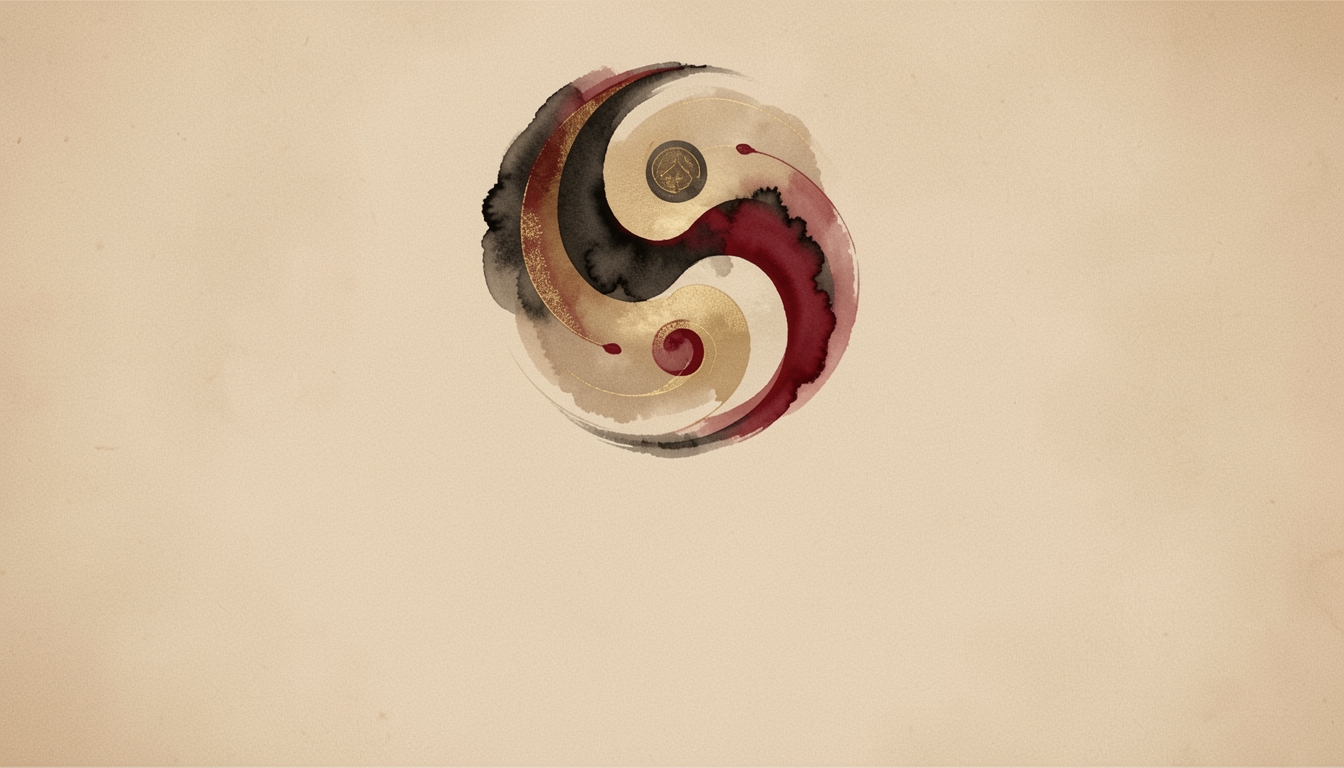
Yin and yang is the most recognized symbol in Chinese thought and the easiest to misunderstand. Most people know the black-and-white circle. Fewer know what it is actually describing. Yin and yang is not a battle between good and evil, and it is not a decoration. It is a language of relationship. It describes how opposites depend on each other, transform into each other, and stay meaningful only in relation to each other.
Contrast With Relationship
The easiest mistake is to think yin and yang means "two opposite things." The deeper point is that the opposites remain connected. Day becomes night. Motion needs stillness. Expansion eventually needs recovery. Without darkness, light is harder to understand. Without rest, activity becomes unsustainable. Yin and yang teaches that contrast is part of how life becomes readable.
This is why the framework appears everywhere in Chinese metaphysics: timing, space, lifestyle, and chart reading all use it.
Why the Symbol Has a Curve and Two Dots
The curved line suggests movement rather than hard separation. Each side contains a dot of the other, which means nothing is perfectly pure forever. Within stillness is the seed of movement; within movement is the need for return. The system expects transformation. A conversation may begin with force and end in reflection. A season may begin light and become heavy.
That expectation keeps the concept alive. Yin and yang is not a flat personality label. It is a way of noticing how qualities shift across time.
Yin and Yang in Everyday Life
You do not need advanced study to see the pattern. A home can feel too exposed or too closed. A schedule can be too scattered or too rigid. A person can overexpress without reflection or overreflect without action. In each case, the problem is not that one pole exists. The problem is that the relationship has become strained.
Used well, the idea guides practical choices: pacing a week, structuring a room, recovering from overwork, or deciding whether a moment calls for speaking or listening.
What Yin and Yang Is Not
It is not a moral ranking. Yin is not "bad" or "passive" in a negative sense. Yang is not automatically "good." Both can become excessive, and both can be necessary. What matters is proportion and fit. The framework also works best alongside other systems, especially the five elements, which add a more detailed language of process.
FAQ
Does yin and yang mean male and female?
Those categories can be discussed through yin and yang, but the framework is much broader than gender. It applies to rhythm, climate, behavior, structure, and change.
Is yin always passive?
No. Yin can describe receptivity, containment, depth, and inward movement. Those are not the same as weakness.
What should I read next?
Read The Five Elements Explained for the next layer of this language.
Where to Go Next
Continue with The Five Elements Explained, browse the general foundations, or return to the article library.